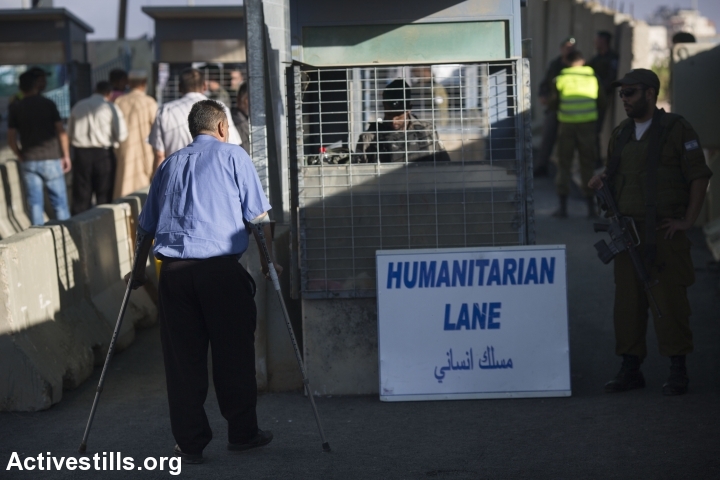
Archive photo: Activestills
During the hearing on a petition seeking to reopen the humanitarian medical corridor from Gaza, Israel’s High Court declined to intervene in the State’s ban on patients from Gaza accessing treatment in the West Bank and East Jerusalem. The judges instead pressed the petitioners to focus their efforts on persuading other countries to accept patients. During the hearing, the Court also rejected three requests to hear from five senior Israeli physicians and ordered the removal of an expert opinion by an American doctor who had worked in Gaza and documented the collapse of its healthcare system.
Israel’s High Court of Justice held a hearing Sunday on a petition filed by five Israel-based human rights organizations – Physicians for Human Rights Israel (PHRI), Gisha, HaMoked: Center for the Defence of the Individual, the Association for Civil Rights in Israel (ACRI), and Adalah – seeking to restore access to medical care for patients from Gaza at hospitals in the West Bank and East Jerusalem.
The corridor would allow patients from Gaza to receive care within the Palestinian healthcare system itself. Palestinian hospitals in the West Bank and East Jerusalem are ready and able to receive patients from Gaza and support would be available to scale up their capacity to meet additional needs. For years, these hospitals have been an integral part of the continuum of care for patients from Gaza, providing specialized treatment unavailable in the Strip.
The case challenges Israel’s policy of blocking the medical corridor that, before October 2023, enabled patients in Gaza to receive specialized treatment unavailable in the Strip. Nearly 18,500 patients and wounded people are now waiting for medical care that cannot be provided in Gaza, according to figures presented by the petitioners.
Much of Sunday’s hearing, however, shifted away from Israel’s legal obligations and toward the role of third countries. Justice Yael Willner told the petitioners to direct the materials they had submitted to the Court to other countries and said that was where they should invest their “considerable efforts.” Justice Yechiel Kasher questioned why countries critical of Israel were not themselves accepting more patients from Gaza.
The exchange came after the judges themselves questioned the State’s position. Israel has both completely blocked the movement of patients between Gaza and the West Bank and declined categorically to consider any mechanism to examine case on an individual basis. Justice Alex Stein said that “there is no such thing as a general policy with zero exceptions,” while Justice Willner challenged the State over its unwillingness to examine individual cases.
Yet after reviewing classified security material presented by the State behind closed doors without the petitioners present, the Court declined to intervene. “At this stage, at this time, we will not intervene,” the judges determined.
The State pointed to medical transfers through third countries as an alternative, despite conceding that this has resulted in a figure of medical evacuees outside of Gaza that constitutes 10% of those accessing healthcare outside of Gaza before October 2023, while the excess injuries and decimated health system only increased the need since October 2023. The petitioners argued that the only sustainable response that can begin addressing the vast needs is a consistent medical corridor between Gaza and the West Bank as a primary solution—essentially the same health system, where many patients’ files already exist, enabling a return to one’s family and importantly to access recurring treatment where needed. Transfers to other countries fall dramatically short of the scale of need and are not a viable option for many patients, including those medically unable to fly.
The Court also repeatedly refused to hear directly from five senior Israeli physicians who attended the hearing to explain the medical consequences of the current policy. Attorney Adi Lustigman, representing the petitioners, asked three times for the doctors to be allowed to address the judges. All three requests were rejected. “With all due respect, we will not allow it,” Justice Willner said on one occasion.
The physicians included senior specialists from Shaare Zedek, Ichilov, Hadassah, Kaplan and Sheba medical centers.
At the start of the hearing, the Court ordered the removal of an affidavit by Dr. Ambreen Sleemi, a U.S. obstetrician-gynecologist and urogynecologist with 30 years of experience who spent six weeks volunteering at Nasser Hospital in Gaza.
Sleemi described severe malnutrition among pregnant women; shortages of medicines, antibiotics, blood and basic wound-care supplies; infants with treatable congenital conditions unable to access the care they needed; cancer patients waiting months for medical transfer; and wounds so severely infected that they became infested with maggots. She wrote that she had never encountered comparable medical conditions in three decades of practice.
Rather than engaging with the medical evidence itself, the Court focused on Sleemi’s criticism of Israel and the Israeli military. Justice Stein said the affidavit contained allegations against Israeli forces that were “not always substantiated” and suggested withdrawing it rather than risk having the petition dismissed outright because of the document. Justice Willner said there was “no justification in the world” for submitting it. The Court subsequently ordered the affidavit removed from the case, describing parts of it as containing “incorrect and offensive statements against the State of Israel and IDF forces.”
According to representatives of the petitioning organizations who were present in court, one judge went so far as to suggest that the petitioners turn to “The Hague” against countries unwilling to accept patients from Gaza. The remark does not appear in the official transcript.
Adv. Adi Lustigman, who represented the five petitioning organizations, said: “The consequences of delaying a decision are not merely legal — they are measured in human lives. Just days ago, Hussein, a ten-and-a-half-year-old boy with leukemia, died after repeatedly waiting for permission to access treatment at a hospital just an hour from his home. Hussein was one of some 4,000 children among 18,500 patients currently in urgent need of medical care that is unavailable in Gaza. We deeply regret that the Defense Minister has failed to give sufficient weight to the lives of these patients, and that the Court failed to recognize the extraordinary urgency of a case in which every delay can cost another life. As long as the State is not required to even consider these requests, patients will continue to die while waiting for treatment that could save their lives.”
Milena Ansari, Director of the Occupied Territory Department at Physicians for Human Rights Israel, said: “The Court was asked a legal question, but responded with a political argument. We laid out Israel’s legal obligations, the urgent humanitarian reality on the ground, and the lives already lost while waiting for medical care. None of these arguments was rebutted. Instead of addressing them, the Court chose to shift responsibility elsewhere. Israel remains an occupying power with clear legal obligations toward the Palestinian population under its control. Deflecting responsibility to third states does not absolve Israel of these obligations.
The Court did not dismiss the petition, but it also granted no immediate relief to patients seeking medical care. Instead, it requested that in a manner that will be decided and communicated later to the parties, a further update be provided, to determine whether the situation has changed.